Wednesday, April 28, 2010

Monday, April 26, 2010
Impasse on mitigating climate change
Yesterday Australia's Prime Minister Kevin Rudd announced that the ETS legislation is being postponed to 2013. In the USA, Republican Senator Lindsay Graham has pulled out of the climate bill, or has he? The fate of this legislation is up in the air.
None of this is good, but nor is it cast in stone. Australia's federal government will be holding elections this year. If by some miracle the Greens got the balance of power, something might happen sooner rather than later and we could yet have a better result than the current ETS.
http://www.abc.net.au/lateline/content/2010/s2884198.htm
In the USA, the situation is still not very clear. It seems that the kerfuffle over there is because Democrat Senator Harry Reid was going to push through the Immigration Bill ahead of the climate and energy bill. But now maybe he won't.
Keep an eye on ClimateProgress for the latest developments on energy legislation in the USA.
None of this is good, but nor is it cast in stone. Australia's federal government will be holding elections this year. If by some miracle the Greens got the balance of power, something might happen sooner rather than later and we could yet have a better result than the current ETS.
LEIGH SALES: So is the current situation, then, nothing better than the Rudd ETS?
BOB BROWN: Well it actually is, because the Rudd ETS, which would have given $24 billion to the big polluters and the Gratton study which we've seen released in the last 24 hours showed that $20 billion of that would have been effectively wasted taxpayers' money, would have not achieved the reduction in greenhouse gas emissions that's required, but would have locked us in to a failure to achieve the necessary reduction for the next 10 to 15 years. We weren't going to allow that to happen.
What we have put forward instead of a proposal to reward the big polluters, a proposal to put a levy onto the big polluters, as Professor Garnaut recommended, so you've got the money to stimulate business, but you also immediately get a reduction in greenhouse gas emissions, something the Rudd scheme would not have done.
http://www.abc.net.au/lateline/content/2010/s2884198.htm
In the USA, the situation is still not very clear. It seems that the kerfuffle over there is because Democrat Senator Harry Reid was going to push through the Immigration Bill ahead of the climate and energy bill. But now maybe he won't.
Keep an eye on ClimateProgress for the latest developments on energy legislation in the USA.
Thursday, April 15, 2010
Clive Hamilton in Huffington Post
Another article on the criminals who are intent on destroying the world.
Clive Hamilton starts off:
Professor Hamilton describes the ever-increasing level of intimidation that scientists are subjected to:
Clive Hamilton starts off:
Is it strange that Sarah Palin, who once thought Africa was a country, now quotes verbatim from emails stolen from Britain's Climatic Research Unit or that Lord Monckton, a leading English climate denier, addresses a Tea Party rally in America?The Tea Party movement doesn't seem to appreciate the irony of being in raptures over a British peer, when it is named for the The Boston Tea Party, which was a direct action by colonists in Boston against the British government.
Professor Hamilton describes the ever-increasing level of intimidation that scientists are subjected to:
One symptom of this shift is the ongoing campaign of cyber-bullying directed at climate scientists themselves. Any climate scientist in the news now receives a torrent of aggressive and abusive emails. As Stanford's prominent climatologist Stephen Schneider says: "It's ugly death threat stuff; 'You belong in jail,' 'You should be executed.' [This] never happened... a year ago. [But] now it's off the charts."Read more here.
Prof Jones and CRU praised & vindicated again
CRU scientists have just been praised for their efforts in a report which once again showed any claims of scientific impropriety and dishonesty are completely false and unwarranted. The review was led by Lord Oxburgh and comprised an international panel of leading experts of impeccable character and credentials. It assessed the integrity of the research published by the Climatic Research Unit in the light of various external assertions.
Will deniosaurs recant their allegations which have again been shown to be completely wrong? Probably not, because there are unfortunately some scurrilous people who are not interested in the truth, only in pushing their own twisted agenda.
As a taster from the Oxburgh panel report:
And more:
And for the critics:
And in regard to FoI:
I agree with them – FoI shouldn’t apply to academic research. I doubt very much that was the intention when FoI was introduced. It just happened that no-one anticipated it would be used to query research, let alone to try to stop research and to threaten scientists, as it has been. It was designed to make administrative decisions more transparent
We cannot simply ignore those who want to destroy what we have. We still need to put in the effort to let people know the extent of the harm we are doing to our world by emitting CO2.
But it's also past time to start taking action individually and collectively, to minimise the harmful effects from the impending climate crash.
And there is a lot we can do, starting with reducing our power bills by being a bit more careful. Some of us will invest in solar power and hybrid cars, which are becoming more affordable. We will urge government to wean us off dirty coal. Geothermic, wind and tidal power are real alternatives that must be used more widely.
We can and will reduce carbon emissions, and with minimal cost if we act quickly - and get a cleaner, greener earth to enjoy.
Will deniosaurs recant their allegations which have again been shown to be completely wrong? Probably not, because there are unfortunately some scurrilous people who are not interested in the truth, only in pushing their own twisted agenda.
As a taster from the Oxburgh panel report:
"We believe that CRU did a public service of great value by carrying out much time-consuming meticulous work on temperature records at a time when it was unfashionable and attracted the interest of a rather small section of the scientific community."
And more:
"We saw no evidence of any deliberate scientific malpractice in any of the work of the Climatic Research Unit and had it been there we believe that it is likely that we would have detected it. Rather we found a small group of dedicated if slightly disorganised researchers who were ill-prepared for being the focus of public attention..."
"...In detailed discussion with the researchers we found them to be objective and dispassionate in their view of the data and their results, and there was no hint of tailoring results to a particular agenda. Their sole aim was to establish as robust a record of centuries as possible. All of the published work was accompanied by detailed descriptions of uncertainties and accompanied by appropriate caveats."
And for the critics:
"We have not exhaustively reviewed the external criticism of the dendroclimatological work, but it seems that some of these criticisms show a rather selective and uncharitable approach to information made available by CRU. They seem also to reflect a lack of awareness of the ongoing and dynamic nature of chronologies, and of the difficult circumstances under which university research is sometimes conducted. Funding and labour pressures and the need to publish have meant that pressing ahead with new work has been at the expense of what was regarded as non-essential record keeping...."
"...Recent public discussion of climate change and summaries and popularizations of the work of CRU and others often contain oversimplifications that omit serious discussion of uncertainties emphasized by the original authors."
And in regard to FoI:
A host of important unresolved questions also arises from the application of Freedom of Information legislation in an academic context.
I agree with them – FoI shouldn’t apply to academic research. I doubt very much that was the intention when FoI was introduced. It just happened that no-one anticipated it would be used to query research, let alone to try to stop research and to threaten scientists, as it has been. It was designed to make administrative decisions more transparent
We cannot simply ignore those who want to destroy what we have. We still need to put in the effort to let people know the extent of the harm we are doing to our world by emitting CO2.
But it's also past time to start taking action individually and collectively, to minimise the harmful effects from the impending climate crash.
And there is a lot we can do, starting with reducing our power bills by being a bit more careful. Some of us will invest in solar power and hybrid cars, which are becoming more affordable. We will urge government to wean us off dirty coal. Geothermic, wind and tidal power are real alternatives that must be used more widely.
We can and will reduce carbon emissions, and with minimal cost if we act quickly - and get a cleaner, greener earth to enjoy.
Monday, April 12, 2010
Melbourne's long summer draws to an end
Six weeks into autumn and Melbourne's record run has ended. The 123-day run of temperatures of 20C or more had it's last day on 10 April, just over four months from when it first began. Yesterday (11 April) the temperature reached a maximum of 18.2C at midnight. Today's maximum was 17.6C at 1:00 pm.
The previous record run in 2000-01 lasted just over two and a half months (78 days), so this summer was quite exceptional.
Hobart's record run of temperatures of 17C or more ended on 2 April, lasting 105 days compared to the previous record of 72 consecutive days. This is only the seventh time since records began that Hobart has had 50 or more consecutive days with a maximum of 17C or more.
The previous record run in 2000-01 lasted just over two and a half months (78 days), so this summer was quite exceptional.
Hobart's record run of temperatures of 17C or more ended on 2 April, lasting 105 days compared to the previous record of 72 consecutive days. This is only the seventh time since records began that Hobart has had 50 or more consecutive days with a maximum of 17C or more.
Friday, April 9, 2010
Affordably Green
I referred to this article by Paul Krugman in a post yesterday. It's worth highlighting, rather than leaving it as an update to my earlier post.
Prof Krugman starts with some basic economic theory, using those poor overused widgets as an example to illustrate the concept of the 'efficiency of free markets'. He then moves on to after-market interventions as a means of ensuring fairness, before discussing 'negative externalities':
Prof Krugman starts with some basic economic theory, using those poor overused widgets as an example to illustrate the concept of the 'efficiency of free markets'. He then moves on to after-market interventions as a means of ensuring fairness, before discussing 'negative externalities':
When there are “negative externalities” — costs that economic actors impose on others without paying a price for their actions — any presumption that the market economy, left to its own devices, will do the right thing goes out the window. So what should we do? Environmental economics is all about answering that question.
One way to deal with negative externalities is to make rules that prohibit or at least limit behavior that imposes especially high costs on others. That’s what we did in the first major wave of environmental legislation in the early 1970s: cars were required to meet emission standards for the chemicals that cause smog, factories were required to limit the volume of effluent they dumped into waterways and so on. And this approach yielded results; America’s air and water became a lot cleaner in the decades that followed.
Krugman goes on to explore some of the downsides of dealing with negative externalities solely by prohibiting them through regulation and introduces the ideas of Arthur Cecil Pigou, from the early 20th century:
...economic activities that impose unrequited costs on other people should not always be banned, but they should be discouraged. And the right way to curb an activity, in most cases, is to put a price on it. So Pigou proposed that people who generate negative externalities should have to pay a fee reflecting the costs they impose on others — what has come to be known as a Pigovian tax. The simplest version of a Pigovian tax is an effluent fee: anyone who dumps pollutants into a river, or emits them into the air, must pay a sum proportional to the amount dumped.
...In practice there are a couple of important differences between cap and trade and a pollution tax. One is that the two systems produce different types of uncertainty. If the government imposes a pollution tax, polluters know what price they will have to pay, but the government does not know how much pollution they will generate. If the government imposes a cap, it knows the amount of pollution, but polluters do not know what the price of emissions will be. Another important difference has to do with government revenue. A pollution tax is, well, a tax, which imposes costs on the private sector while generating revenue for the government. Cap and trade is a bit more complicated. If the government simply auctions off licenses and collects the revenue, then it is just like a tax. Cap and trade, however, often involves handing out licenses to existing players, so the potential revenue goes to industry instead of the government.
In Krugman's article he looks further into options for policies aimed at reducing carbon emissions, comparing the relative merits and downsides different approaches. He follows up with estimates of the cost of doing something and doing nothing - which are at this time somewhat speculative. What is clear is that doing something sooner will be less costly than delaying action.
The truth is that there is no credible research suggesting that taking strong action on climate change is beyond the economy’s capacity. Even if you do not fully trust the models — and you shouldn’t — history and logic both suggest that the models are overestimating, not underestimating, the costs of climate action. We can afford to do something about climate change.
I highly recommend reading the full article in the New York Times Magazine.
The truth is that there is no credible research suggesting that taking strong action on climate change is beyond the economy’s capacity. Even if you do not fully trust the models — and you shouldn’t — history and logic both suggest that the models are overestimating, not underestimating, the costs of climate action. We can afford to do something about climate change.
I highly recommend reading the full article in the New York Times Magazine.
Running out of news?
George Monbiot is reluctantly letting go of the email affair with one last article. Surely he has some real science to write about?
I suppose for Monbiot, this is a sort of apology for being too quick to judge, which he might have realised after he read Steve Easterbrooks excellent post. But it's not enough in my opinion. Monbiot should be grovelling in apology to Professor Jones and his colleagues at CRU. Instead he's still going on about the importance of FoI (and takes a lot of the credit for the FoI legislation being passed).
Monbiot admits that the legislation is designed to help ensure government decisions are transparent. What he doesn't say is that FoI was never intended to impede scientific research. In my opinion it probably shouldn't apply to research. Administrative decisions and personal information held by a university is one matter, using FoI to delay important research and threaten scientists is quite another matter.
The cost to the UK taxpayers from this sad affair has been high, not just in terms of the financial and other resources diverted from other pressing matters to Parliamentary Committee Hearings and the University's email review and review of the science, but in terms of the public's understanding of the threat from CO2 emissions. The personal cost to some of the world's leading scientists is appalling, for which journalists shoulder a lot most of the blame.
At the end of the day, the science is sound and little has changed, which was undoubtedly the intention of the FoI spammers and email larcenists. Copenhagen didn't go as well as hoped. There has since been some progress but not yet enough.
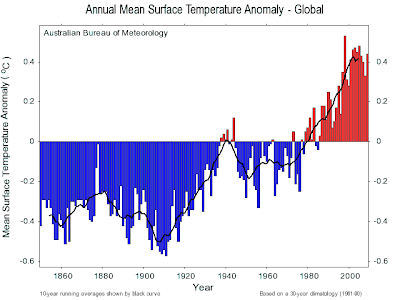
Meanwhile, as this chart from the Australian Bureau of Meteorology shows, it's still hotting up.
I suppose for Monbiot, this is a sort of apology for being too quick to judge, which he might have realised after he read Steve Easterbrooks excellent post. But it's not enough in my opinion. Monbiot should be grovelling in apology to Professor Jones and his colleagues at CRU. Instead he's still going on about the importance of FoI (and takes a lot of the credit for the FoI legislation being passed).
Monbiot admits that the legislation is designed to help ensure government decisions are transparent. What he doesn't say is that FoI was never intended to impede scientific research. In my opinion it probably shouldn't apply to research. Administrative decisions and personal information held by a university is one matter, using FoI to delay important research and threaten scientists is quite another matter.
The cost to the UK taxpayers from this sad affair has been high, not just in terms of the financial and other resources diverted from other pressing matters to Parliamentary Committee Hearings and the University's email review and review of the science, but in terms of the public's understanding of the threat from CO2 emissions. The personal cost to some of the world's leading scientists is appalling, for which journalists shoulder a lot most of the blame.
At the end of the day, the science is sound and little has changed, which was undoubtedly the intention of the FoI spammers and email larcenists. Copenhagen didn't go as well as hoped. There has since been some progress but not yet enough.
Meanwhile, as this chart from the Australian Bureau of Meteorology shows, it's still hotting up.
Subscribe to:
Posts (Atom)