Showing posts with label global warming. Show all posts

Wednesday, May 29, 2013

The Heat is On....Stop Procrastinating, People


Don't take comfort from the Bayesians or other low estimates of climate sensitivity - this study says it's going to get bad, and worse if we don't act now...


Uncertainty no excuse for procrastinating on climate change


By Roger Bodman, Victoria University and David Karoly, University of Melbourne

Today we released research which reduces the range of uncertainty in future global warming. It does not alter the fact we will never be certain about how, exactly, the climate will change.

We always have to make decisions when there are uncertainties about the future: whether to take an umbrella when we go outside, how much to spend on insurance. International action on climate change is just one more decision that has to be made in an environment of uncertainty.

The most recent assessment of climate change made by the Intergovernmental Panel on Climate Change in 2007 looked at what is known with high confidence about climate change, as well as uncertainties. It included projections of future global warming to the end of this century based on simulations from a group of complex climate models.

These models included a range of uncertainties, coming from natural variability of the climate and the representation of important processes in the models. But the models did not consider uncertainty from interactions with the carbon cycle – the way carbon is absorbed and released by oceans, plant life and soil. In order to allow for these uncertainties, the likely range of temperature change was expanded.
Our recent study has re-visited these results and tested an approach to reduce the range of uncertainty for future global warming. We wanted to calibrate the key climate and carbon cycle parameters in a simple climate model using historical data as a basis for future projections. We used observations of atmospheric carbon dioxide concentrations for the last 50 years to constrain the representation of the carbon cycle in the model. We also took the more common approach of using global atmospheric and ocean temperature variations to constrain the response of the climate system.

This led to a narrower range of projected temperature changes for a given set of greenhouse gas emissions. As a consequence, we have higher confidence in the projections. In other words, using both climate and carbon dioxide observations reduces the uncertainties in projections of global warming. (Click the chart to enlarge it.)


Figure 1. Global-mean temperature change for a business-as-usual emission scenario, relative to pre-industrial. Black line: median, shaded regions 67% (dark), 90% (medium) and 95% (light) confidence intervals. The sidebars are uncertainty ranges based on the IPCC likely range and best estimate (grey column) for 2090-2099 and our corresponding results (purple column) from the simple climate model (MAGICC); the black bars are the respective best estimates (modified from Nature Climate Change paper). Bodman & Karoly

We found that uncertainties in the carbon cycle are the second-largest contributor to the overall range of uncertainty in future global warming. The main contributor is climate sensitivity, a measure of how the climate responds to increases in greenhouse-gas concentrations.

Climate sensitivity has been discussed recently on The Conversation. A recent study by Alexander Otto of Oxford University and colleagues, published in the journal Nature Geoscience, also considered future global warming in the context of observations of global mean temperature change over the last decade.
Unlike that study, our results do not show lower climate sensitivity or lower mean projected global warming. Our study uses the same observed global atmospheric and ocean temperature data. But we also used observed carbon dioxide data and represented important additional processes in our simplified climate model, particularly the carbon cycle on the land and in the ocean and uncertainties in the climate forcing due to aerosols.

In our study, the reductions in uncertainty came from using the observations, the relationships between them and how these affect the parameters in the simple climate model. We found 63% of the uncertainty in projected warming was due to single sources, such as climate sensitivity, the carbon cycle components and the cooling effect of aerosols, while 37% of uncertainty came from the combination of these sources.
Once we reduced the uncertainty we found there is an increased risk of exceeding a lower temperature change threshold, but a reduced chance of exceeding a high threshold. That is, for business-as-usual emissions of greenhouse gases, exceeding 6°C global warming by 2100 is now unlikely, while exceeding 2°C is virtually certain.

These results reconfirm the need for urgent and substantial reductions in greenhouse gas emissions if the world is to avoid exceeding the global warming target of 2°C. Keeping warming below 2°C is necessary to minimise dangerous climate change.

It is unlikely that uncertainties in projected warming will be reduced substantially. Indeed, if you allow for population growth, levels of economic activity, growth in demand for energy and the means of producing that energy, overall uncertainty increases. We just have to accept that we will have to manage the risks of global warming with the knowledge we have. We may not know exactly how much and by when average temperatures change, but we know they will. This is an experiment we probably don’t want to make with the only planet we have to live on.

Roger Bodman received funding from the Australian Research Council while completing his PhD.
David Karoly receives funding from the Australian Research Council and the Australian Antarctic Division. He is a Chief Investigator in the ARC Centre of Excellence for Climate System Science, a member of the Climate Change Authority and a member of the Science Advisory Panel to the Climate Commission.

The Conversation
This article was originally published at The Conversation. Read the original article.

Saturday, February 26, 2011

Cardinal Pell backs Plimer against the Pope and the Catholic Church

As discussed in the Sydney Morning Herald and numerous other places, Cardinal George Pell has made a bit of a fool of himself on the record in the Australian Parliament's primary record, Hansard. In line with his numerous pronouncements that global warming is not a threat (such as here), Pell wrote to the Senate to immortalise his lack of understanding of climate science and his faith in a book of 'science fiction' that was penned by a chap called Ian Plimer.

Tim Lambert has published Pell's letter and the response from Dr Greg Ayers of the Bureau of Meteorology. Dr Ayers explains to the Senate Committee, why Ian Plimer's book is not credible.

Pell is in conflict with the Pope on the matter of global warming and has probably been in conflict with the Vatican for twenty years or more, on human welfare and environmental matters generally. Here is an excerpt from Pope Benedict XVI World Peace Day address last year (which refers also to concerns in 1990 expressed by Pope John Paul II):
4. Without entering into the merit of specific technical solutions, the Church is nonetheless concerned, as an “expert in humanity”, to call attention to the relationship between the Creator, human beings and the created order. In 1990 John Paul II had spoken of an “ecological crisis” and, in highlighting its primarily ethical character, pointed to the “urgent moral need for a new solidarity”.[7] His appeal is all the more pressing today, in the face of signs of a growing crisis which it would be irresponsible not to take seriously. Can we remain indifferent before the problems associated with such realities as climate change, desertification, the deterioration and loss of productivity in vast agricultural areas, the pollution of rivers and aquifers, the loss of biodiversity, the increase of natural catastrophes and the deforestation of equatorial and tropical regions? Can we disregard the growing phenomenon of “environmental refugees”, people who are forced by the degradation of their natural habitat to forsake it – and often their possessions as well – in order to face the dangers and uncertainties of forced displacement? Can we remain impassive in the face of actual and potential conflicts involving access to natural resources? All these are issues with a profound impact on the exercise of human rights, such as the right to life, food, health and development.

Click for the Pope's World Day of Peace message - 1 January 2010

And the US Conference of Catholic Bishops (USCCB) is as strong or stronger on the issue than the Pope and the Vatican, and writes:
The U.S. Catholic bishops have declared, "At its core, global climate change is not about economic theory or political platforms, nor about partisan advantage or interest group pressures. It is about the future of God's creation and the one human family. It is about protecting both 'the human environment' and the natural environment." (Global Climate Change: A Plea for Dialogue, Prudence and the Common Good, United States Conference of Catholic Bishops, 2001, p.1).
In parishes, dioceses and other Catholic organizations, we encourage efforts to bring about a discussion on climate change that is civil and constructive, that invokes the virtue of prudence in seeking solutions, and that is more responsive to the needs of the poor, both here in the United States and abroad. As Catholics, we have a unique opportunity and responsibility to make a difference in addressing the potential impacts of global climate change, particularly on those least able to bear its burdens.

The USCCB urges specific action at the personal, state, national and global level; including at the national level:
The U.S. Catholic bishops are urging that any legislative action on climate change include provisions that: (1) ease the burden on poor people; (2) offer some relief for workers who may be displaced because of climate change policies; and (3) promote the development and use of alternate renewable and clean-energy resources, including the transfer of such technologies and technical assistance that may be appropriate and helpful to developing countries in meeting the challenges of global climate change.
Write to your Senators and Representatives in Congress and let them know that you care about climate change and support action on a national level that includes the three key priorities above. For background information on the issue, go to http://www.usccb.org/sdwp/ejp/climate.
Keep up to date on new science and technology relating to climate change by checking the websites of the National Academies of Sciences (http://www.nasonline.org) and the Intergovernmental Panel on Climate Change (IPCC) (http://www.ipcc.ch/).

Cardinal Pell backs Plimer against the Pope and the Catholic Church

As discussed in the Sydney Morning Herald and numerous other places, Cardinal George Pell has made a bit of a fool of himself on the record in the Australian Parliament's primary record, Hansard. In line with his numerous pronouncements that global warming is not a threat (such as here), Pell wrote to the Senate to immortalise his lack of understanding of climate science and his faith in a book of 'science fiction' that was penned by a chap called Ian Plimer.

Tim Lambert has published Pell's letter and the response from Dr Greg Ayers of the Bureau of Meteorology. Dr Ayers explains to the Senate Committee, why Ian Plimer's book is not credible.

Pell is in conflict with the Pope on the matter of global warming and has probably been in conflict with the Vatican for twenty years or more, on human welfare and environmental matters generally. Here is an excerpt from Pope Benedict XVI World Peace Day address last year (which refers also to concerns in 1990 expressed by Pope John Paul II):
4. Without entering into the merit of specific technical solutions, the Church is nonetheless concerned, as an “expert in humanity”, to call attention to the relationship between the Creator, human beings and the created order. In 1990 John Paul II had spoken of an “ecological crisis” and, in highlighting its primarily ethical character, pointed to the “urgent moral need for a new solidarity”.[7] His appeal is all the more pressing today, in the face of signs of a growing crisis which it would be irresponsible not to take seriously. Can we remain indifferent before the problems associated with such realities as climate change, desertification, the deterioration and loss of productivity in vast agricultural areas, the pollution of rivers and aquifers, the loss of biodiversity, the increase of natural catastrophes and the deforestation of equatorial and tropical regions? Can we disregard the growing phenomenon of “environmental refugees”, people who are forced by the degradation of their natural habitat to forsake it – and often their possessions as well – in order to face the dangers and uncertainties of forced displacement? Can we remain impassive in the face of actual and potential conflicts involving access to natural resources? All these are issues with a profound impact on the exercise of human rights, such as the right to life, food, health and development.
Click for the Pope's World Day of Peace message - 1 January 2010

And the US Conference of Catholic Bishops (USCCB) is as strong or stronger on the issue than the Pope and the Vatican, and writes:
The U.S. Catholic bishops have declared, "At its core, global climate change is not about economic theory or political platforms, nor about partisan advantage or interest group pressures. It is about the future of God's creation and the one human family. It is about protecting both 'the human environment' and the natural environment." (Global Climate Change: A Plea for Dialogue, Prudence and the Common Good, United States Conference of Catholic Bishops, 2001, p.1).
In parishes, dioceses and other Catholic organizations, we encourage efforts to bring about a discussion on climate change that is civil and constructive, that invokes the virtue of prudence in seeking solutions, and that is more responsive to the needs of the poor, both here in the United States and abroad. As Catholics, we have a unique opportunity and responsibility to make a difference in addressing the potential impacts of global climate change, particularly on those least able to bear its burdens.
The USCCB urges specific action at the personal, state, national and global level; including at the national level:
The U.S. Catholic bishops are urging that any legislative action on climate change include provisions that: (1) ease the burden on poor people; (2) offer some relief for workers who may be displaced because of climate change policies; and (3) promote the development and use of alternate renewable and clean-energy resources, including the transfer of such technologies and technical assistance that may be appropriate and helpful to developing countries in meeting the challenges of global climate change.
Write to your Senators and Representatives in Congress and let them know that you care about climate change and support action on a national level that includes the three key priorities above. For background information on the issue, go to http://www.usccb.org/sdwp/ejp/climate.
Keep up to date on new science and technology relating to climate change by checking the websites of the National Academies of Sciences (http://www.nasonline.org) and the Intergovernmental Panel on Climate Change (IPCC) (http://www.ipcc.ch/).

Sunday, February 20, 2011

The ecology crisis and shrinking biodiversity in a warming world

I'm putting together a few links on ecology and biodiversity. Most nature lovers will have observed changes in their local flora and fauna in recent years. There will be many more changes over coming years as species are affected by the altered atmosphere and the warming earth, which will have multiple and cascading effects affecting food webs and local habitats. Here is some further reading on the subject.

Jeff Harvey responded to Eli Rabett's request for reading material and suggested places to start learning about the biodiversity crisis. Dr Harvey recommends the Millenium Assessment Reports as a starting point.

Bart has posted some useful links on the topic, and the thread includes some excellent posts by Jeff Harvey and Bernard J, though the thread got hijacked further along the way. There is discussion of the Amazon, on inter-relationships and how broken links will have a cascading effect; and the notion of 'extinction debt' and the lingering inevitable death of species.

My attention was drawn to this observation by Bernard J., because it relates to the mountains I love and look on every day from my window, (although I am not aware of any Gondwanan Nothofagus within walking distance of our place):
In Australia one good example is the remnant Gondwanan Nothofagus forest associations clinging to the tops of the highest mountain peaks along the Great Dividing Range. Whilst they might be able to persist in warm temperatures, they do not thrive as well as the pyrophilic eucalptus associations at lower altitude. Even slight warming increases the frequency of fire, and the capacity for eucalypts to regenerate more quickly than the Nothofagus will see the latter continue to retreat to the apices in the face of advancing eucalyptus forest, and then blink out when there is no more mountain left. This will remove thousands of species unque to the Nothofagus associations, simply because of the vulnerability of one foundation species.

This post on climate change and extinction, from Kate at ClimateSight, is worth reading and reading again. In it she looks at how past extinction events provide ample warning of the disaster we face.

SkepticalScience.com has a post about extinctions, written by Barry Brook.

Some biodiversity blogs are listed on the Pimm Group website.

And for those of us who have recently experienced extreme heat, and wondered if we and other species would survive very high temperatures and humidity if it lasted for more than a few days, the answer is probably not, as discussed here.

An illustration of what happens when one part of the food chain is seriously diminished in numbers, is discussed in this recent article about the current reduction in the number of larger fish in the ocean.

Some scientists are proposing intervention by eliminating specific threatened species for the greater good of many more species. A topic that would be highly controversial in the public arena, one imagines.

Wednesday, April 7, 2010

Around the blogs ...

Atmoz is taking taking bets on when atmospheric levels of carbon dioxide will first reach 400 ppm, going by data from NOAA. Pop on over to register your bet. I took a punt on April 2014, given that industry is gearing up again after the financial crisis. Hopefully I'm wrong and all the renewable alternatives will start to kick in soon. Most other people are betting sometime in 2015 or 2016.

Watching the Deniers has likened 'climategate' to the wheeze of an asthmatic ant and is asking people to come up with a more apt name for this non-event. Why not post your suggestion to his blog, or a similar request made shortly afterwards on ClimateProgress?

Deltoid has some recent posts on McLean and McKitrick complaining (separately) about how they can't seem to get their work published in any reputable science journal. Both seem to be digging themselves into a deeper hole by declaring their incompetence in climate science to the general public, rather than keeping it within the scientific community. DeepClimate has delved further into the McItrick complaint. (Dare I say McItrick can't win a trick?)

WottsUpWithThat continues to do an excellent job of showing up denier posts. In regard to Anthony's efforts to raise a few bucks by selling his mobile UHI detector, there's a warning of some adjustments you might need to make here. Otherwise it might be just another CHI detector (car heat island) or an AHI detector (asphalt heat island) or even an RHFTM detector (reflected heat from the mirror). Before making such purchases, it's advisable to make sure your BS detector is working.

The EPA (USA) has published its response to public comments received on the Proposed Findings in relation to the Endangerment and Cause or Contribute Findings for Greenhouse Gases under the Clean Air Act. Eli Rabett has been picking through the some of the more ignorant comments (submitted by those who should know better), and the EPA responses here and here and here and here and here.

Eli has also noted that the CRU is highlighting the 'defamatory reporting' of a posting on the “Climate Audit” website, managed by Steve McIntyre. McIntyre has caught sight of his tail out of the corner of his eye and can't stop chasing it. Around and around he goes from FOI to Law Domes and back again. There has been nothing new from him for several months. It doesn't stop him from trying to get heard by sending submissions to the UK House of Commons Committee and the Russell Inquiry. His submission to the latter is an attack on the members of the Commission, which I wouldn't have thought would win him any Brownie points. Maybe it's because McIntyre has run out of nits to pick. Is it time to peek behind the curtain?

The Arctic ice in March

The National Snow and Ice Data Centre has just released it's latest monthly report. It said that the maximum ice extent in the Arctic was reached on 31 March this year, which was the latest maximum since satellite records began in 1979. The previous latest date was on March 29, 1999 (two days earlier than the maximum this year).

The Bering and Baltic seas were where ice extent increased, driven mainly by cold weather and winds from the north. Elsewhere it decreased or was near average.

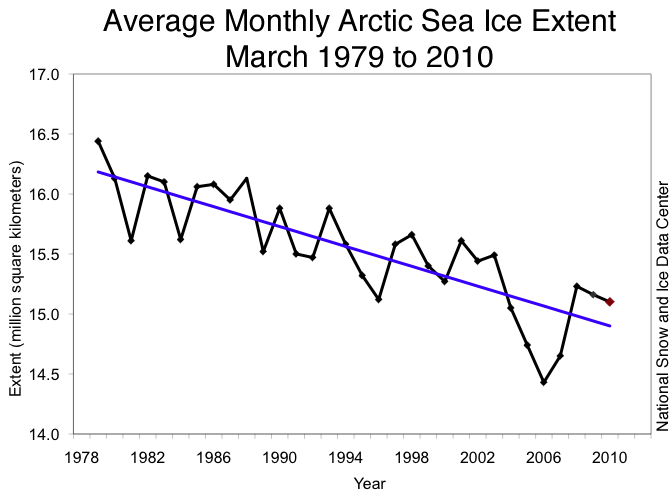
The maximum extent was 15.25 million square kilometers (5.89 million square miles). This was 670,000 square kilometers (260,000 square miles) above the record low maximum extent, which occurred in 2006. Usually there is a decrease in ice during March, but this March the ice extent grew at an average of 13,200 square kilometers (5100 square miles) per day. The linear rate of decline for March over the 1978 to 2010 period is 2.6% per decade as shown in this chart from the National Snow and Ice Data Centre.


The Centre reports that the younger multi-year ice was replenished a bit this winter and the strong negative Arctic Oscillation prevented as much ice from moving out of the Arctic. The report was noncommittal on the expectations for summer ice melt, except to say:
The larger amount of multiyear ice could help more ice to survive the summer melt season. However, this replenishment consists primarily of younger, two- to three-year-old multiyear ice; the oldest, and thickest multiyear ice has continued to decline. Although thickness plays an important role in ice melt, summer ice conditions will also depend strongly on weather patterns through the melt season.
The report also states that there aren't any satellites taking ice thickness measurements across the whole of the Arctic right now:
At the moment there are no Arctic-wide satellite measurements of ice thickness, because of the end of the NASA Ice, Cloud, and Land Elevation Satellite (ICESat) mission last October. NASA has mounted an airborne sensor campaign called IceBridge to fill this observational gap.

If you go to the NSIDC website, there are some good images showing the change in ice thickness over the past twenty years or so, with the decline in older ice overall, and the slight recovery this past year.

Monday, April 5, 2010

Melbourne beats record warm days by >50%

A couple of weeks ago I posted here about Melbourne's record 100 consecutive days of 20C or more. The previous record was in 2000-01 when it had 78 consecutive days at 20C or warmer. That's just over two and a half months of consistently warm weather.

Today will make it 118 days (nearly four months), which beats the previous record by 51%, which is almost one and a half months more. And theforecast for the next 7 days shows it isn't over yet.

Monday, March 29, 2010

Polar extremes

The arctic is warming, a lot! Antarctica as a whole is not warming like the arctic. Why the difference?

The arctic is mostly ocean covered in floating ice. It is warming faster than most other places on earth and the sea ice is rapidly melting.

Antarctica is the driest continent on earth. The climate there has been significantly modified by the ozone hole. It's not warming as fast as the arctic, but the glacial melt is contributing to rising sea levels, and could realistically add more than one metre to sea levels within the next 90 years.

Ozone declined rapidly last century and is only now stabilising. It is expected to largely recover to 1980 levels by the middle of this century.

The depletion of ozone has changed the polar vortex, which extends from the surface to the stratosphere and follows the earth's contour lines at the south pole. The loss of ozone from 1980 onwards strengthened the polar vortex winds by 15%. The winds driven by the ozone hole are shielding eastern Antarctica from the warming that is affecting the rest of the world. However, the winds transfer down to the surface and are carrying warm air to western Antarctica, where glaciers are melting.

Low pressure cells over the Amundsen Sea are forcing up deep water, which is warmer than 1°C. This warmer water is getting in under the Pine Island Glacier and melting it from below.

Of 244 Antarctic Peninsula glaciers, 87% have retreated over the last 50 years.

For a comprehensive and up-to-date reading on the Antarctic, see the Turner et al SCAR report of Antarctic Climate Change and the Environment, which was released in November 2009.

A recent slide presentation (Feb 2010) based largely on the above report can be seen here.

Saturday, March 20, 2010

100 day warm record for Melbourne

Melbourne has broken yet another climate record. Last November (2009), the extended heatwave meant that the average temperature for the month was 5.3C above the 1961-1990 average (that's 9.5F for those still on the old scale). The average minimum was 3.9C above the 1961-1990 average minimum. That's for a whole month. Pretty incredible.

Now Melbourne has just had 100 straight days of temperatures higher than 20C, and it's not over yet. Now anyone who knows Melbourne knows how unusual that is, you don't need to go to the records. But if you do go to the records, the closest it's come in the recorded past is 78 days in 2000-01. By the way, the recorded past goes back to 1855.

Something is happening in the State of Victoria. It's called climate change and in Melbourne it's warming!

Friday, March 5, 2010

A highly simplified view of global warming

To change the climate of the entire earth requires a change in the balance of radiation.

Energy in = energy out - stable climate
Energy in less than energy out - earth gets cooler (ice ages)
Energy in more than energy out - earth gets warmer (interglacials)

Temperature is one way of measuring energy. The same object measured at a higher temperature has more energy than that object when it's cooler.

When as much energy goes out of the earth as comes into the earth, there won't be a global temperature change. There will continue to be changes in climate in different parts of earth but it will balance out over the whole earth.

The temperature of the whole earth is rising and has been more or less doing so since about the time the industrial revolution took off. This rise in temperature can in essence be only from one of two causes. Either there is more energy coming in from the sun or there is less energy going back out to space from the earth. (If the earth was cooling it would be the reverse.)

The reason the earth is warming is that the earth is holding in more energy than is going out into space. Since the middle of the 20th century, measurements of the sun's energy and the earth's current orbit and the way it is aligned to the sun show that the earth has not been receiving more energy from the sun. (Before this time, some of the extra heat can be attributed to there being more energy coming in from the sun as well as the extra CO2.)

The greenhouse effect describes how earth retains heat to support life on earth. The recent rise in temperature is mainly caused by the large rise in one of the greenhouse gases, CO2, which means less energy is being radiated out, which means the earth is getting warmer. As a result of this initial warming, there are other effects that all add to the change - water vapour, which is another greenhouse gas, increases and lets even less energy escape, ice reduces and means less energy is reflected out to space, and so on.

Eventually, the energy state will re-balance. The temperature will stabilise at a new higher level and the amount of energy coming in will again equal the amount of energy going out.

An analogy of the adjustment to the change in energy balance is - if you turn on a tap over the sink and allow the water to drain out the plughole. If you partly plug up the drain then water will start to rise in the sink. There will be more water coming in from the tap than going down the drain. This is the same effect as adding more CO2 blocks some of the heat from leaving the earth, and the energy increases and temperature rises. For a while the water will continue to rise in the sink (similar to the temperature going up) until it reaches a point where the water coming out of the tap equals the water going down the drain. The pressure of the water in the sink will cause more water to go down the drain and equalise with the water coming out of the tap. The water level will be higher when it equalises, just like the temperature will be higher when the earth's energy balance gets to a new equilibrium.

The above description is a very simplistic description of the situation. Much more detail is available from reputable sources closer to the science itself. Check the links here for a more detailed and scientific explanation and other related information.

Sub-sea methane instability

As reported today in various media, including Climate Progress, an NSF article and the Wall Street Journal, there is a paper in the current edition of Science that points to an urgent need for further research into methane venting from sub-sea deposits in the arctic.

If the measured CH4 escaping from the shallow seas is a new phenomenon, then it has serious implications for the climate. Current climate models do not provide for this, and in the near term, it would mean a sudden warming of the earth if the vast amounts of trapped methane were to escape to the atmosphere.